
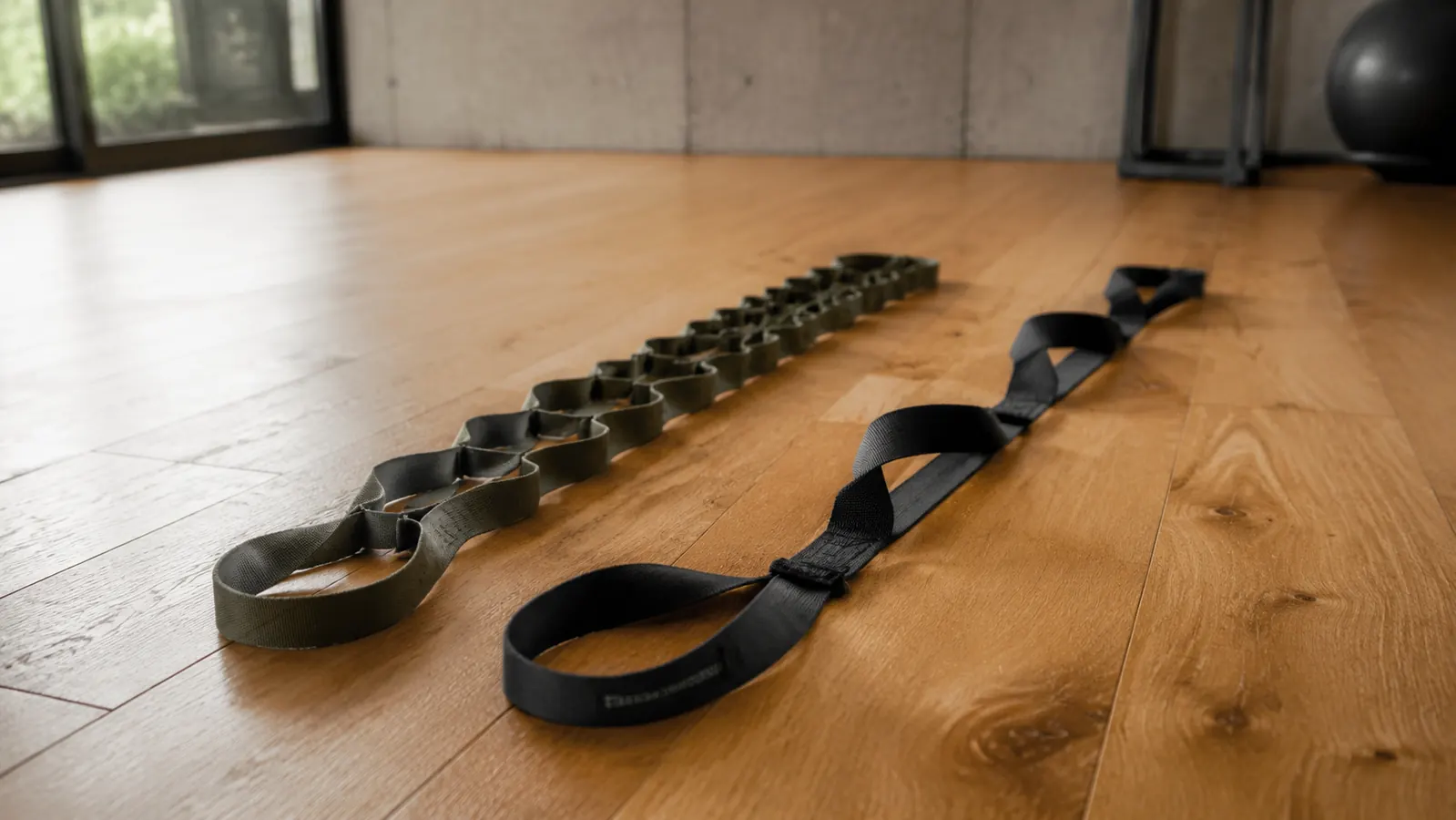
If you searched 'stretching strap for recovery' on Amazon, you have probably seen both of these show up in the first few results. The OPTP Stretch Out Strap has been around since the 1980s and shows up in physical therapy clinics. The Tumaz yoga strap is a newer, budget-friendly option with a flexible buckle and a sleek design. Both cost in the budget range. So does it actually matter which one you buy?
The short answer is yes, it matters, but mostly for one reason: the OPTP was designed specifically for guided, incremental stretching with multiple loop positions, while the Tumaz was designed as a yoga prop for holding a pose. If you are recovering from a hard workout or dealing with chronic tightness in your hamstrings, hip flexors, or calves, those are meaningfully different tools.
| OPTP Stretch Out Strap | Tumaz Yoga Strap | |
|---|---|---|
| Length | 60 inches | 60 inches (also available in 72 and 96 in.) |
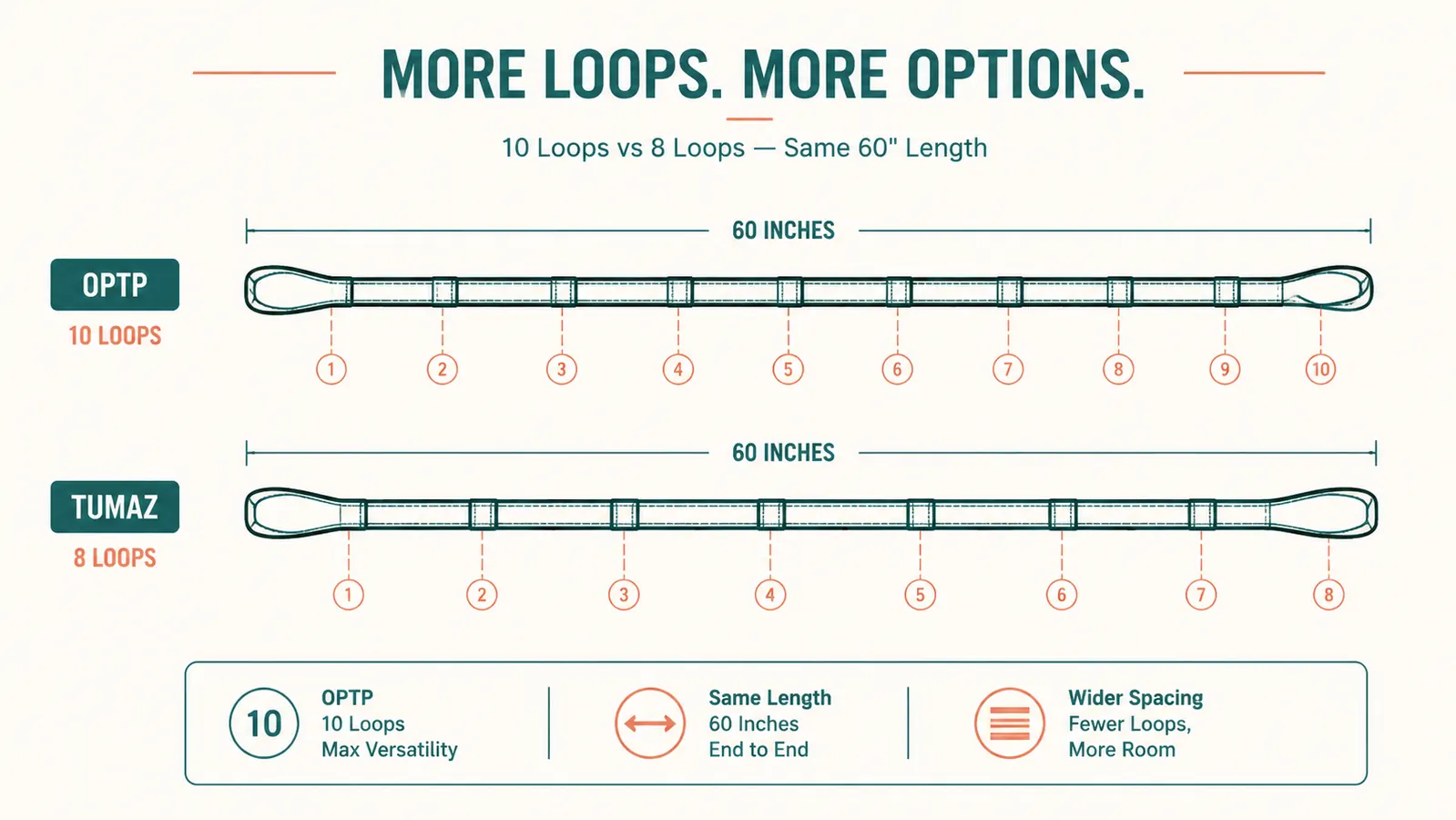
| Number of loops | 10 evenly-spaced loops | 8 wider loops |
| Loop spacing | Approx. 3 inches apart, allows fine-grained reach adjustment | Approx. 5-6 inches apart, less precision per position |
| Material | Heavy-duty cotton webbing, no hardware | Durable cotton or nylon blend with metal D-ring buckle |
| Included instruction | Comes with a 14-exercise illustrated booklet | No instruction booklet included |
| Buckle / fastener | No buckle, loops only | Metal D-ring buckle for adjustable length |
| Primary design intent | Physical therapy and assisted stretching | Yoga prop and pose support |
| Amazon rating | 4.7 stars (27,000+ reviews) | 4.8 stars (35,000+ reviews) |
| Approximate price | Budget-friendly | Budget-friendly |
Where the OPTP Stretch Out Strap Wins
The OPTP wins on loop granularity, and that matters more than it sounds. When you are trying to stretch a tight hamstring without forcing your hip into flexion before it is ready, the ability to move one loop closer or farther gives you real control over your range of motion. You can inch your way into a deeper stretch session by session instead of jumping from too easy to too far in one position change. That precision is exactly why physical therapists have used this strap as a clinical tool for decades.
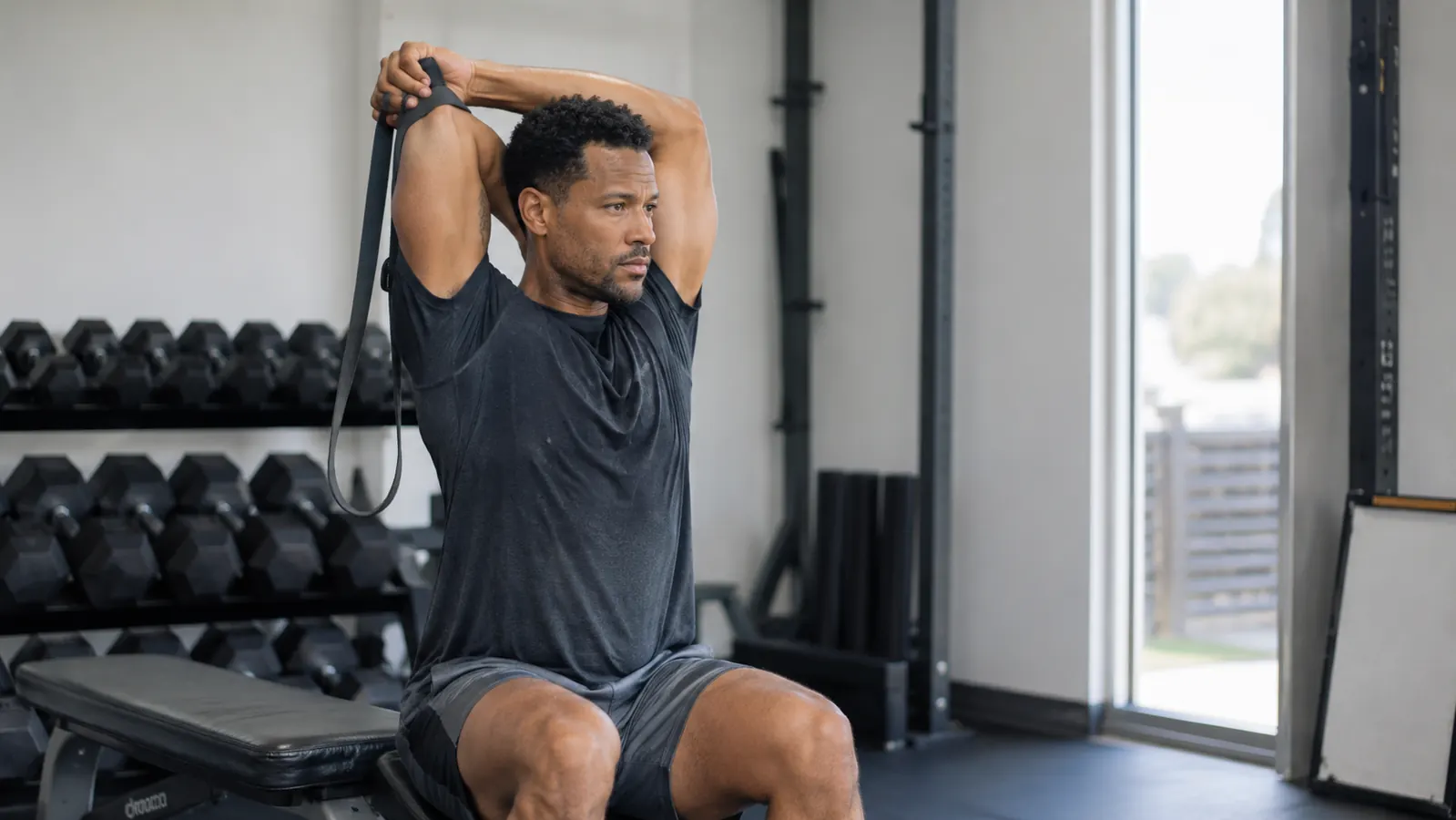
The included exercise booklet is another legitimate advantage. It is not a throw-in marketing pamphlet. The 14 illustrated exercises cover hamstrings, calves, hip flexors, quads, IT band, and the upper body, with clear loop-position callouts for each one. If you are new to structured stretching or coming back from a sedentary stretch after an injury, that booklet takes out the guesswork entirely. You do not need to search YouTube for a stretching routine. The instructions come in the box. That combination of hardware and guidance in a single budget-friendly purchase is genuinely hard to beat.
The cotton webbing without any hardware also means there is nothing to dig into your foot or hand during a stretch. No metal buckle pressing against your arch when you loop it around your foot in a supine hamstring stretch. For anyone who has ever had a D-ring edge graze their ankle mid-stretch, that is not a small thing.
Tight hamstrings and no idea where to start? The OPTP includes the instruction book.
Over 27,000 Amazon reviews and a 4.7-star rating back up what physical therapists have recommended for 40 years. One strap, 10 loops, 14 guided exercises.
Amazon Check Today's Price on Amazon →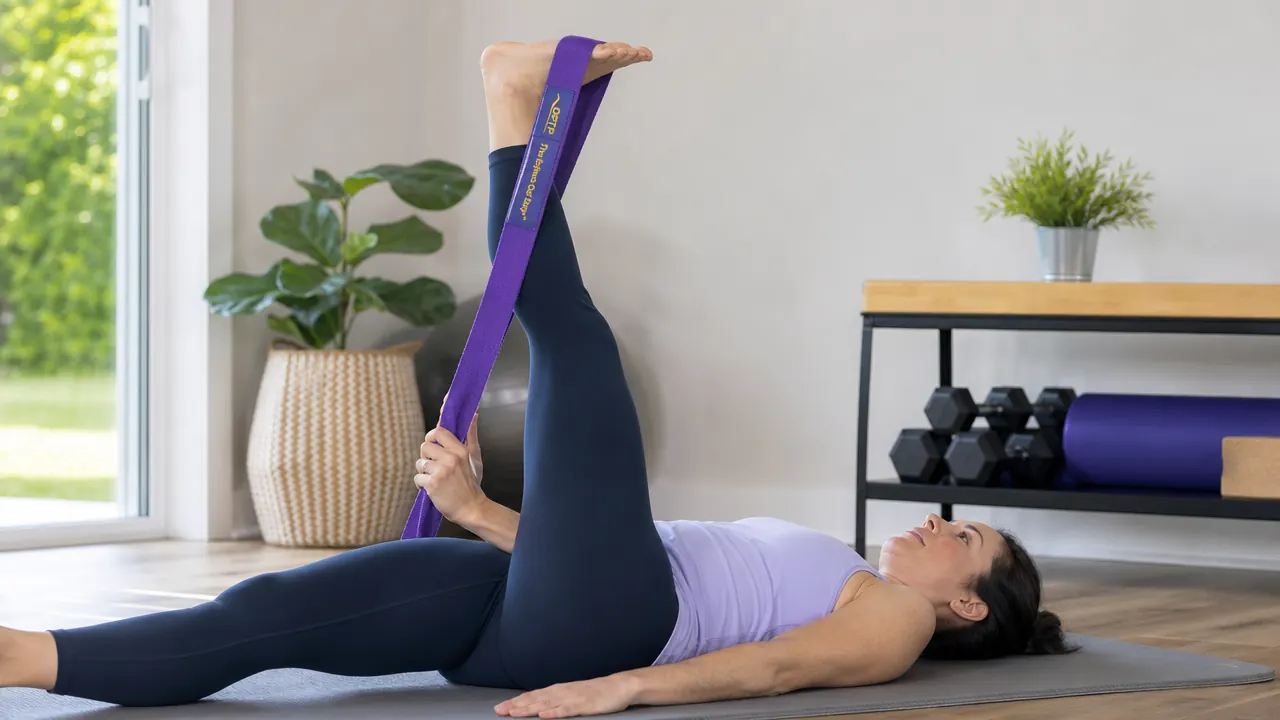
Where the Tumaz Wins
The Tumaz yoga strap has one clear structural advantage: the D-ring buckle. If you want to form a stable loop around your foot and hold a position without actively gripping the strap, the buckle lets you set the loop size and leave it. That is useful for certain yoga poses and for holding a stretch passively while you focus on breathing rather than hand grip. If you practice yoga regularly alongside your training, the Tumaz fits natively into that context.
Length flexibility is another edge. The Tumaz comes in 60-, 72-, and 96-inch versions, which matters for taller athletes or for exercises where a longer reach is an advantage. The OPTP comes in one 60-inch length. For most adults under 6 feet tall, 60 inches is sufficient for hamstring and shoulder work, but if you are a taller person or want the extra length for partner stretching, the Tumaz gives you that option. The price gap also makes the Tumaz an easy entry point if you are not yet committed to structured stretching and just want to try it.
The OPTP's 10 loops are not a marketing gimmick. Each position is a meaningful 3-inch step in your range of motion, and that incremental control is exactly what makes it useful for recovery, not just yoga.
Loop Count: Why It Actually Matters for Recovery Work
This is the technical detail that most comparison articles skip over, so let's be specific. When you do a supine hamstring stretch, you raise your leg and use the strap to hold it in place while your muscle lengthens. The ideal stretch position is just past the point of initial resistance, not at maximum range. With the OPTP's 10 loops spaced 3 inches apart, you have fine control: you can be in loop six today and loop seven in three weeks as your flexibility improves. With the Tumaz's 8 wider loops, each step is a bigger jump. That is fine for holding a yoga pose, but in a recovery context where you are trying to make incremental gains and avoid overstretching a healing muscle, wider spacing gives you less precision.
The other factor is durability at the loop points. The OPTP stitching is reinforced at each individual loop, and the brand has a 40-year track record of clinical-level durability. The Tumaz loops are also stitched, but the D-ring buckle area is the most likely failure point over time, and several long-term reviews mention the ring showing wear after 12 to 18 months of heavy use. Neither strap will fall apart under normal home use, but the OPTP has the longer proven track record.
Who Should Buy the OPTP Stretch Out Strap
Buy the OPTP if your main goal is structured flexibility work for recovery. If you are dealing with chronically tight hamstrings that affect your running form, hip flexors that limit your squat depth, or calf tightness that keeps your ankles stiff after long training days, the OPTP gives you the most direct path from 'stiff and frustrated' to 'consistently more mobile.' The included exercise booklet means you do not need any background in flexibility training to use it correctly. You open the box, follow the illustrations, and use the loop that puts you right at your current range of motion limit. For busy active adults who want a tool that works without requiring research, this is the right pick.
The OPTP is also the right choice if you want something that will stay in your kit for years. At a low price point, it is not a gamble, but the cotton webbing construction and reinforced loops mean you are not going to replace it. Physical therapy clinics use these because they hold up under constant daily use. A home athlete using it five or six times a week is well within what this strap was built for. For more on long-term durability and how the strap performs across specific muscle groups, see the full year-long OPTP Stretch Out Strap review.
Who Should Buy the Tumaz Yoga Strap
Buy the Tumaz if you already practice yoga and want a strap that fits seamlessly into a yoga context. The buckle makes it practical for yoga poses that require holding a loop at a fixed circumference, and the wider loops are perfectly adequate for the kind of static holding most yoga sequences call for. If you are taller than 6 feet and find 60 inches limiting, the longer Tumaz options are also worth considering. And if you are budget-constrained and just want to experiment with strap stretching before committing to a pricier option, the Tumaz costs about half of what the OPTP does.
Where the Tumaz falls short is in the guided recovery context. There is no instruction booklet, the loop spacing is less precise, and the design was not built around incremental therapeutic stretch progression. If your goal is to systematically improve hamstring and hip flexibility for athletic performance or post-workout recovery, the Tumaz will work, but you will feel the gap compared to the OPTP once you try to fine-tune your stretch position.
The Verdict: Which One to Buy
For the specific audience this site is built for, active adults in their 30s, 40s, and 50s who want to recover faster and maintain mobility for training, the OPTP Stretch Out Strap is the clear pick. The 10-loop design gives you precision the Tumaz cannot match. The exercise booklet means you start using it correctly on day one. The cotton webbing is comfortable in hand and against your foot. And affordably priced, the value proposition is nearly impossible to argue against.
The Tumaz is a solid yoga prop and a decent general-purpose strap. But 'decent' is not what most people shopping for a recovery tool actually need. If you want to understand the full performance picture before buying, the honest OPTP review covers what the product does well and where its limits are, which should answer any remaining questions about fit for your situation.
Ready to add structured stretching to your recovery routine? The OPTP is the one that earns its spot.
A 4.7-star rating from over 27,000 verified buyers. Comes with a 14-exercise illustrated booklet. Budget-priced and built to last. This is the strap physical therapists have been handing patients for 40 years.
Amazon Check Today's Price on Amazon →